
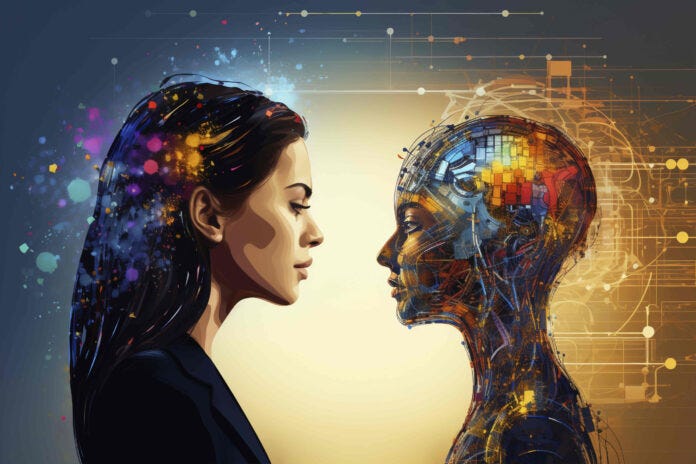
‘Man is but a reed, the most feeble thing in nature - but he is a thinking reed’ (Blaise Pascal)
Pascal wrote that in the 1600s. He had no idea about artificial intelligence, and yet he nailed the entire argument in one sentence. We have spent centuries building tools to compensate for our physical limits and now we’ve built one that compensates for our mental ones. The only thing left that is entirely, irreducibly ours is the thought that starts it all.
The world has fundamentally changed post AI, but more recently after Claude Code. Anthropic’s agentic tool has solved the knowledge acquisition issue that inhibited many to achieve certain things that seemed impossible for them. For example, I am a beginner coder who has yet to find his way through a series of coding languages, but just last week I prompted Claude to make me a multi-functional data analytics dashboard, which it did in just 10 minutes. No bugs, no downtime and incredibly accurate.
That isn’t a flex. That’s the point.
A few weeks ago that dashboard didn’t exist because I didn’t have the technical skills to build it. The knowledge gap that stood between my idea and its execution would have been years of learning, trial and error, expensive developers now all collapsed into a ten-minute conversation. The barrier wasn’t removed by me becoming smarter. It was removed by me thinking clearly about what I actually wanted and asking the right questions to get it.
That’s the shift nobody is talking about loudly enough. It was never really about who could code, who could design, who had the technical vocabulary. It was always about who had the clearest vision of what they were trying to build. The execution just got democratised overnight.
The Fear Is Real. So Let’s Address It.
People aren’t being dramatic when they worry about their jobs. Entire industries are watching AI absorb tasks that used to take teams of people months to complete. Anthropic released a breakdown of which roles are most exposed to automation and it is hard to look at that data and not feel something shift in your stomach. Copywriters, analysts, paralegals, junior developers — the anxiety is everywhere and it is not irrational.
So go into work tomorrow and ask yourself three honest questions. Is what I do replaceable? Do I add value that is genuinely difficult to replicate? And, most uncomfortably — why couldn’t AI do my job better than I do?
Those are not questions designed to break you. They are questions designed to wake you up.
Because here is what the fear consistently misses. AI is an extraordinary executor. It is trained on the sum of human knowledge, it does not sleep, it does not have bad days, and it does not ask for a raise. On pure execution, it wins. But execution was never the whole game. It was just the part we chose to measure because it was the easiest thing to see.
What Art Has Always Known
Creativity has always been the purest expression of human thought. That is why we pay millions for a painting. That is why we still study Shakespeare, Dostoyevsky, and Tolstoy in schools and universities centuries after they wrote their last word.
Think about that for a moment. We do not return to those works because the prose was technically superior or because the vocabulary was more advanced. We return because they were authentic. Because you can feel a real human life behind every sentence. The specific grief, the specific joy, the specific way a person saw the world at a particular moment in time and decided to put it down on the page.
Mozart did not write music that AI cannot technically replicate note for note. What AI cannot replicate is why he wrote it. The tension between genius and mortality. The specific texture of an eighteenth century life pressing itself into a composition. That is not data. That is not pattern recognition. That is a soul leaving a mark.
Even in recent history you see it. Think about what Kanye West did to music in the early 2000s. The sound was genuinely different since it was not just well executed, it was a specific mind expressing a specific vision that nobody else had. That kind of artistic courage is increasingly rare. Much of what gets made now is technically competent and emotionally inert. We have plateaued. And I think, quietly, people feel it. They keep going back to the classics not out of nostalgia but because authenticity has a frequency that resonates in a way no generated content can match.
Humans like what is real. That instinct is not going away.
Redefining What Intelligence Actually Means
For most of human history, intelligence was measured through execution. How quickly you could learn a skill, how much you could retain, how reliably you could produce output. The ratio between thought and execution was always weighted toward the end result. Ideas were all well and good, people said, but show me what you built.
That framework made sense when execution was hard. It no longer makes sense.
The greatest execution engine ever built is now available to anyone with a WiFi connection and a clear thought in their head. Which means the old metrics are not just outdated but they are actively misleading. If you are still optimising to be a better executor in a world that just automated execution, you are running the wrong race.
The human moat is thought. Original, specific, courageous, sometimes deeply inconvenient thought.
Think about what it meant to be considered intelligent 100 years ago. You memorised things. You recalled them accurately and deployed them quickly. A doctor carried an entire pharmacopoeia in their head. A lawyer had case law at their fingertips. A banker could run calculations in the time it took others to find a pen. That was the performance of intelligence — the visible, impressive retrieval and application of stored knowledge. We built our entire educational system around it. We still largely have. I am not suggesting knowledge retrieval isn’t a sign of intelligence, but with the tools we have now, isn’t this just a complete anachronism.
Since retrieval was never really the point. It was a proxy. We measured it because we had no better way of accessing what was actually happening underneath; the synthesis, the intuition, the strange lateral leap that connected two ideas nobody had thought to put in the same room before. Those things were always the engine. The memorisation was just the tax you paid to get to them. Now the tax is gone. Which means for the first time in human history we are forced to confront intelligence as it actually is, stripped of the performance that used to surround it. And what we find, when we look honestly, is that the most important thinking has always been the kind that made people slightly uncomfortable. The thought that arrives uninvited. The conclusion that contradicts what you were supposed to believe. The idea that sounds absurd until, one day, it doesn’t. That is the thinking that moves things forward. It always was. We just spent a very long time rewarding everything else instead.
This Is Not a Doom Piece
I want to be clear about something. This is not an article about how humans are insignificant. This is not the energy I am bringing to this.
This is about the window. Every compression event in human history — the Industrial Revolution, the printing press, the internet which created a generation of people who saw the moment clearly and moved. Not because they were the smartest people in the room, but because they were paying attention and they backed themselves.
That window is open right now. Probably not for long.
So go and pursue the business idea you have been sitting on for two years. Back the project you have genuinely always loved. Invest in the thing you keep saying you will do when the timing is right.
Because the timing is always right.
Final Word
Thinking is what separates us from every other species on this planet and, for now at least, every machine we have ever built. But here is the thing that gets me every time I sit with this idea. Thinking is also what unites us. Every single person reading this has had a thought that changed them. A moment of clarity in the shower. An idea on a walk that made them stop. A question they could not shake for years until suddenly the answer arrived.
That is the common thread. Across cultures, across centuries, across every difference that makes us who we are individually — we are all, at our core, thinking reeds.
Pascal knew it. Shakespeare lived it. And right now, in this strange and genuinely unprecedented moment, the world is paying a premium for it.
That brain of yours is magic. Use it.